What Must You See At The National Gallery In London?
Discover the must-see masterpieces at the National Gallery, from Van Gogh’s Sunflowers to Turner’s Fighting Temeraire, plus practical tips on tickets, guided tours, and how to plan your visit.
 By James Whitfield, London Museums And Travel Writer
What Must You See At The National Gallery In London?
If you have one hour, aim for Van Gogh’s Sunflowers, Turner’s The Fighting Temeraire, Holbein’s The Ambassadors, and Botticelli’s Venus and Mars. Those four alone give you a survey of European art from the Renaissance through the late 19th century. With two hours, add the Wilton Diptych, Leonardo’s Virgin of the Rocks, and Seurat’s Bathers at Asnières. The gallery’s collection runs from the 13th to the early 20th century, so a focused route is the difference between a memorable hour and a blur of gold frames. The free floor plan you pick up at the entrance marks a dozen star paintings; follow that and you will walk straight into the finest Renaissance, Dutch Golden Age, and Impressionist works the gallery owns.
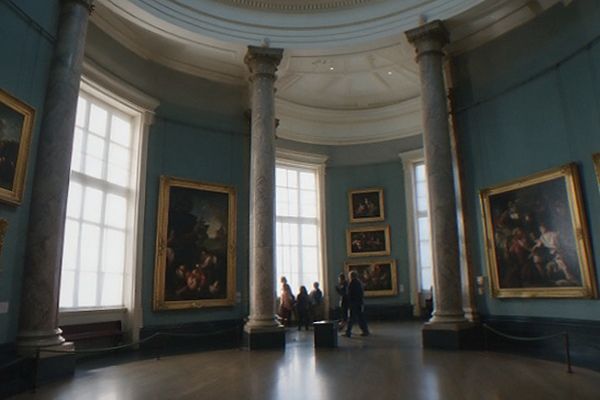
Most visitors arrive expecting a museum-sized puzzle, but the National Gallery is deliberately compact. All of the rooms spread across a single floor on the north side of Trafalgar Square, and you can walk from the Sainsbury Wing entrance to the far east rooms in four minutes. That geography means you can dip into the highlights, take a break in the central café, and return without losing your bearings. The room numbers are sequential and clearly signposted on the map, so you will not need a phone app unless you want an audio guide.
The gallery sits at the heart of London, and its own London Museums guide covers 48 institutions across the city, from free collections like this one to ticketed palaces. The permanent collection here is always free, year-round, and you do not need a ticket to walk in. The one thing that regularly catches visitors out is the layout: the main entrance on Trafalgar Square leads into the Sainsbury Wing, which houses the early Renaissance, while the grand central hall on the opposite side often goes unnoticed. For the route above, enter through the Sainsbury Wing, head toward the medieval panels at the far end of that wing, then work your way east through the chronological galleries toward the Impressionist rooms.
The building itself is worth a moment of attention before you dive into the paintings. The Sainsbury Wing, designed by Robert Venturi and opened in 1991, is a deliberate counterpoint to the neoclassical main building, with a quieter, more intimate entrance sequence that gradually opens into the larger galleries. Once you cross into the older part of the museum, the scale shifts dramatically, with high ceilings and long sightlines that let you spot a major painting from three rooms away. That architectural rhythm, small rooms opening into grand ones, is part of what makes the visit feel manageable rather than overwhelming. If you want a more structured experience, several art-focused London museums pair naturally with this one, and a well-planned route across two or three of them can fill a rewarding day.
How Long Should You Spend At The National Gallery?
For a first visit, plan on two to three hours. That is enough time to see 15 to 20 major works without museum fatigue. If you want to linger over the collection, four hours covers the permanent rooms comfortably, and a full day lets you add a temporary exhibition and a proper lunch at the café. The gallery opens daily from 10 am to 6 pm, with a late opening on Friday until 9 pm. Friday evenings are noticeably quieter, and the lower light in the rooms creates a calmer viewing experience than the midday crowds.
Because the permanent collection is free, you can break the visit into two short sessions if your hotel is nearby. Start with an early-morning hour when the doors open, step out for a Trafalgar Square coffee, then return for a second stint in the afternoon. School groups tend to fill the rooms between 11 am and 2 pm on weekdays, so the early and late windows are the quietest. Even on a busy Saturday, the large rooms like the central hall absorb crowds well, and you rarely have to queue to stand in front of a painting. The only pinch points are directly in front of the Sunflowers and The Ambassadors, where a polite wait of a minute or two is normal.
One factor that eats into your time is the temporary exhibition queue. Blockbuster shows often require a timed entry slot booked days in advance, and you still join a short line to enter the exhibition space. That line adds 10 to 15 minutes to your schedule, so if you have a timed ticket, factor that in. The permanent rooms, by contrast, have no timed entry at all and you simply walk in. If you are visiting on a tight schedule, skip the temporary show on a first trip and spend every minute with the permanent collection. The temporary exhibitions rotate every few months, so you can always catch one on a return visit. For a broader look at how the gallery fits into a longer itinerary, the guide to whether the Courtauld Gallery is worth it explains how the two collections complement each other within a single afternoon.
What Does A National Gallery Ticket Cover?
Entry to the permanent collection is always free. You only pay for tickets to the temporary exhibitions, which typically cost £15 to £25. A guided tour booked online includes your exhibition access and an in-depth walk with an art historian. Advance booking is strongly recommended for any blockbuster show; the gallery’s own website and the live listings usually release tickets four to six weeks before the exhibition opens. No booking is required for the free permanent collection, though you can reserve a free timed slot on the official site during exceptionally busy holiday periods, which saves you from a short wait at the door.
The guided tour ticket is the most practical way to see the highlights without standing in front of a dozen paintings wondering which one matters. A guide takes you straight to the works the gallery is most famous for and gives you the context that the wall labels cannot: why Holbein’s skull is distorted unless you stand at the right angle, why Turner’s ship is being towed to the breakers, and what the dog in Van Eyck’s Arnolfini Portrait really means. The tour lasts about an hour and a half and lets you re‑enter the permanent rooms on your own afterward, which means you get the educational value of a guide without losing the freedom to revisit the paintings that caught your eye. Reviews on the live listing sit at 3.7 across 196 opinions, which reflects a mix of enthusiastic praise and a few visitors who wished the group size had been smaller. The cancellation terms on the listing let you cancel up to 24 hours in advance for a full refund, so there is little risk in reserving a slot early.
For visitors who prefer to explore independently, the free floor plan is genuinely good. It prints a shortlist of highlights with thumbnail images and room locations, and you can follow it at your own pace without a phone or a map. The audio guide, available for a small fee at the entrance, adds a curator’s commentary to about 80 works and is a solid middle ground between a guided tour and wandering alone. If you are trying to decide between the two, the guided tour is better for a first visit when you want the narrative structure; the audio guide suits a second or third visit when you have already seen the star paintings and want to go deeper on the ones you missed.
How Does The National Gallery Compare To Other London Art Museums?
The National Gallery is the best place to see Western European painting from the Middle Ages to the dawn of modernism. Tate Modern covers modern and contemporary art from the 20th century onward. The Courtauld Gallery houses a small but exceptional collection of Impressionist and Post‑Impressionist works. If you want the full sweep of Western art, visit all three. If you only have time for one, the National Gallery offers the broadest overview. The V&A is the nearest large rival, but its strength lies in decorative arts, sculpture, and design rather than paintings. The Wallace Collection, 15 minutes up the road in Marylebone, is a free museum of old masters set in a historic townhouse, and it makes an excellent pairing if you have a second morning to fill.
The Moco Museum, a short walk from Marble Arch, takes a completely different approach: modern and contemporary works, often with a digital or street‑art edge, in a relatively small space. It is a good counterpoint to the National Gallery’s classical collection, especially if you are travelling with teenagers who glaze over at gilded frames. The Courtauld is even more compact, housed in Somerset House, and its Impressionist room is one of the finest in London, with a Manet, a handful of Monets, and a Cézanne that draws visitors who skip the bigger museums altogether.
For a visitor spending a weekend in London, a sensible art itinerary starts with the National Gallery on Saturday morning, followed by the Courtauld in the afternoon. Sunday is then free for Tate Modern and the Moco Museum if modern work interests you. All four are centrally located, and the walk from Trafalgar Square to Somerset House takes under 10 minutes, while the Tate Modern is a leisurely stroll across the Millennium Bridge. The Courtauld, in particular, rewards visitors who have just come from the National Gallery because its Impressionist paintings pick up chronologically right where the National Gallery’s collection leaves off. You can stand in front of a late Turner at the National Gallery and then, 20 minutes later, stand in front of an early Monet at the Courtauld and see the direct line of influence. For more on what that smaller gallery offers, the post on whether the Courtauld Gallery is worth visiting breaks down its collection and practical details.
The Moco Museum, by contrast, makes no attempt at chronological continuity. Its strength is the immediate visual hit of large-scale contemporary pieces, from immersive digital installations to works by Banksy and Koons. It suits a visitor who wants a jolt of colour and wit after an hour of old masters, and its location near Marble Arch means you can walk there from the National Gallery in about 20 minutes through St James’s and Mayfair. If you are building an art day that moves from the historical to the contemporary, the National Gallery in the morning, a lunch break, then the Moco in the afternoon is a logical progression that avoids the fatigue of too many gilt frames in a row.
What Are The Best Things To See For A First‑Time Visitor?
First‑time visitors should make a beeline for Van Gogh’s Sunflowers, Turner’s The Fighting Temeraire, and Holbein’s The Ambassadors. In an hour and a half you can see all three, plus Botticelli’s Venus and Mars and Leonardo’s Virgin of the Rocks. Grab the free floor plan at the entrance and you will not miss a thing. Those five paintings alone give you a crash course in the evolution of technique and subject matter: the precise symbolism of the Renaissance, the light and colour of the Dutch Golden Age, the drama of Turner’s seascapes, and the emotional punch of the Impressionists.
The painting that surprises most people on a first walk‑through is Velázquez’s The Rokeby Venus, the only surviving female nude by the Spanish master. It hangs in the Spanish rooms toward the east end of the gallery, and its composition, with Cupid holding a mirror, has inspired centuries of artists and a famous suffragette attack in the early 20th century. Another work that rewards a closer look is Van Eyck’s Arnolfini Portrait, a small panel in the northern Renaissance rooms that packs in a wealth of domestic detail and a convex mirror that reflects two tiny figures, one of them possibly the artist himself. The gallery label explains the theories, but seeing it in person is the kind of moment that makes a guided tour worthwhile.
If the galleries feel crowded, the quieter rooms are often the most rewarding. The Spanish and German rooms in the east wing rarely have more than a handful of visitors, and you can sit on a bench in front of a Zurbarán still life with almost no one else around. The early Italian altarpieces in the Sainsbury Wing are another pocket of calm, with the gold‑ground panels glowing under low light and a hush that feels almost chapel-like. These rooms are easy to miss because visitors tend to surge toward the Impressionists, but skipping them means missing the Giotto and Duccio panels that set the foundation for everything that follows.
| Masterpiece | Artist | Location | What to look for |
|---|---|---|---|
| Sunflowers | Van Gogh | Impressionist rooms | The thick impasto and the signature on the vase |
| The Fighting Temeraire | Turner | British rooms | The ghostly ship and the tiny tugboat |
| The Ambassadors | Holbein | Early Northern rooms | The distorted skull at the bottom: stand to the right side to see it |
| Venus and Mars | Botticelli | Early Italian rooms | The wasps buzzing around Mars’s head |
| Virgin of the Rocks | Leonardo | Early Italian rooms | The soft sfumato blending the figures into the rock background |
| The Rokeby Venus | Velázquez | Spanish rooms | The mirror held by Cupid, which does not quite reflect what you expect |
| Arnolfini Portrait | Van Eyck | Early Northern rooms | The tiny figures in the convex mirror and the dog at the couple’s feet |
| Bathers at Asnières | Seurat | Impressionist rooms | The pointillist dots that dissolve into colour when you step back |
| The Wilton Diptych | Unknown master | Early Italian rooms | The gold ground and the white hart badge of Richard II |
| The Hay Wain | Constable | British rooms | The way the sky takes up most of the canvas |
The table above hits the works that appear on the gallery’s own shortlist. If you follow that list from room to room, you will cross the entire floor plan in a logical chronological sweep, ending near the east exit. A second visit could take in the Dutch genre scenes, where Vermeer’s two small paintings sit quietly among the Steens and De Hoochs, or the Monet and Renoir canvases near the Van Gogh wall. Those Dutch rooms deserve more time than most visitors give them: Vermeer’s A Young Woman standing at a Virginal and A Young Woman seated at a Virginal are the only two Vermeers the gallery owns, and they sit in a small side room that most people walk straight past on the way to the café. The still lifes by Pieter Claesz and Willem Kalf in the same suite are worth slowing down for, too, because the detail in a single lemon peel or a pewter jug is astonishing when you step close enough to see the brushwork.
The gallery’s strength is not just the individual masterpieces but the way they talk to each other across the rooms. Turner’s The Fighting Temeraire hangs near Constable’s The Hay Wain in the British rooms, and seeing them side by side makes the contrast between Turner’s atmospheric haze and Constable’s crisp, almost photographic detail immediately obvious. A few rooms away, the French Impressionists pick up the thread of light and atmosphere that Turner started, and you can trace a direct line from one to the next. The floor plan makes these connections easy to follow because the rooms are arranged broadly by school and century, and the free map colours each zone so that you know at a glance whether you are in the Italian Renaissance, the Dutch Golden Age, or the 19th-century French rooms.
For visitors with a specific interest, the gallery’s website lists themed trails that you can download before you arrive: one on animals in art, another on fashion through the centuries, and a family trail designed to keep children engaged with a series of look-and-find prompts. The family trail works surprisingly well for adults, too, because it forces you to notice the small details you would otherwise skim past: a parrot in a corner, a reflection in a mirror, a dog that appears in three different paintings by three different artists.
What Should You Know About Practicalities Before You Go?
The nearest Tube station is Charing Cross, a two‑minute walk from the main entrance. The gallery is open daily from 10 am to 6 pm, with Friday late opening until 9 pm. There is no cloakroom for large suitcases, so travel light. Security at the entrance is quick but thorough: bags are checked, and you walk through a metal detector. The queue to enter the building is rarely more than five minutes, though it can stretch to 15 on a Saturday in August. If you see a long line snaking across the portico, it is almost always for a special exhibition, not for general admission. Walk to the door marked for the permanent collection and you will be inside in under a minute.
The gallery café on the ground floor serves sandwiches, salads, and hot meals until about an hour before closing, and it overlooks a small courtyard. Prices are typical for a central London museum: a coffee and a pastry come to about £6, and a sit‑down lunch is £12 to £18. Several pubs within a five‑minute walk offer better value, and the outdoor seating on Trafalgar Square is a decent spot for a sandwich from a nearby café. If the weather is fine, take your coffee onto the portico steps and sit looking out at Nelson’s Column; it is one of the best people-watching spots in London and costs nothing.
The gallery shop, located just past the central hall, stocks an excellent range of art books and prints, and the print‑on‑demand service can produce a high‑quality reproduction of almost any painting in the collection. Expect to pay around £25 for an A3 print, which is rolled into a tube you can carry onto a flight. The shop stays open until 6 pm daily and until 9 pm on Fridays.
Accessibility is good throughout the building. Level access is available at the Sainsbury Wing entrance, and lifts connect all floors. Wheelchairs and portable stools can be borrowed free of charge from the information desk. The gallery also runs regular BSL-interpreted tours and relaxed openings for visitors who benefit from a quieter environment. Check the official National Gallery site for the current schedule of accessible events and late‑night openings. For information on tours, the live listing page gives real‑time availability and same‑day booking for the guided tour.
If you are combining the National Gallery with a trip to the Courtauld Gallery, walk through Somerset House and cross Waterloo Bridge for one of the best river views in the city, then loop back along the South Bank. That walk adds about 20 minutes to the journey but turns a simple transfer into a highlight of the day. For a different perspective on the gallery’s place in London’s art scene, the article on what not to miss at Tate Modern covers the modern counterpart across the river.
The National Gallery sits directly on Trafalgar Square, which means that several other central London attractions are within an easy walk. The National Portrait Gallery is literally next door, sharing the same block on St Martin’s Place, and it is also free. St James’s Park, a five-minute walk to the south, offers a green escape if you need fresh air between gallery sessions. Leicester Square and Covent Garden are both within a 10-minute walk to the northeast, which puts the gallery at the centre of a walkable day that can include art, lunch, and an evening show without ever getting on the Tube.
One last practical note that saves frustration: the gallery has free Wi‑Fi throughout, and the signal is strong enough to stream the audio guide if you prefer to use your own phone. Download the gallery’s app before you arrive and you can pull up information on any painting by typing its inventory number from the wall label. The app also includes a searchable map that locates you within the building, which is useful if you have wandered off the marked trail and want to find your way back to a specific room without backtracking.
Common Questions About Visiting The National Gallery
What must you see at the National Gallery in London?
In an hour, focus on Van Gogh’s *Sunflowers*, Turner’s *The Fighting Temeraire*, Holbein’s *The Ambassadors*, and Botticelli’s *Venus and Mars*. With more time, add the Wilton Diptych, Leonardo’s *Virgin of the Rocks*, and Seurat’s *Bathers at Asnières*.
Do you need a ticket to enter the permanent collection?
No. The permanent collection is free and you can walk in without a ticket. Free timed entry slots are sometimes available on the official site during busy holidays, but they are not required.
How much does a guided tour cost?
A guided tour that includes a temporary exhibition and expert commentary typically starts from $27.09 USD. Check the operator’s live listing for the current price and availability.
How long does it take to see the highlights?
Most visitors see the top masterpieces in about two hours. A full walk of all the permanent rooms takes four to five hours. Friday evenings are the quietest time to visit.
Is the National Gallery worth it if you are only in London for a weekend?
Yes. It is centrally located, free, and houses some of the most famous paintings in the world. A focused two‑hour visit can easily fit into a weekend itinerary without feeling rushed.